


Note: This site is moving to KnowledgeJump.com. Please reset your bookmark.
Feelings and Performance
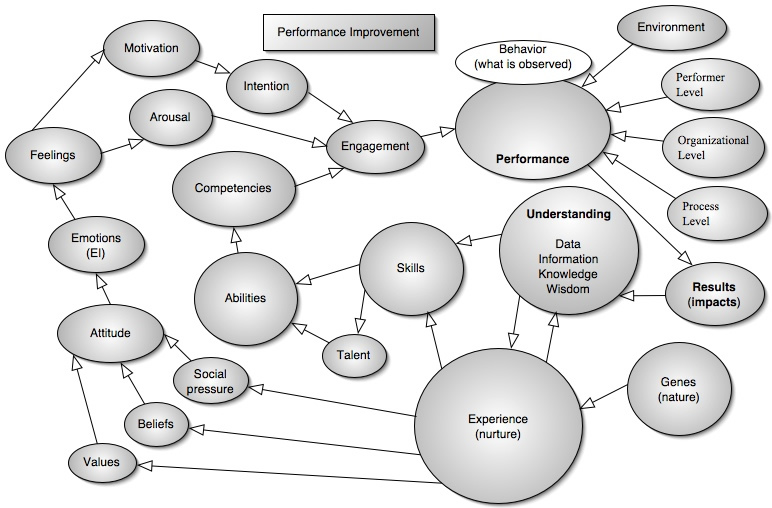
Feeling is largely thought to be a mapping of a particular body state by the mind in which a mental image (map) is formed. Thus, feeling, in essence, is an idea. In turn, that idea resides within the person.
This “mapping” of the body is composed of sensory feelings, called “affects,” that are directly evoked by specific inputs from the internal self and/or external environment. They include such evaluative experiences as hunger, thirst, pain, and sweetness (Johnston, 1999). Feelings are not neutral, but rather hedonic in that they are either positive or negative, such as pleasantness or unpleasantness.
Unlike emotions, such as pride or anger, they occur in the absence of any complex cognitive processes.
Reference
Johnston, Victor S. (1999). Why We Feel: The Science of Human Emotions. Cambridge, Massachusetts: Perseus Books, p.61.