Note: This site is moving to KnowledgeJump.com. Please reset your bookmark.
Leadership Development Model
What use is magic if it can't save a unicorn? - Peter S. Beagle, The Last Unicorn
What use is leadership if it can't be developed by the organization?
The Leadership Development Program page answers why we need leadership development programs; the next stage is to answer, “How?”
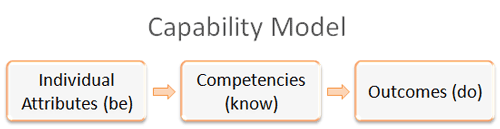
It helps to break the leadership development project down into chunks, in order to make it more manageable. Fortunately, we have the help of the U.S. Army and the Defense Department who undertook a similar approach in the early 1990s with a project led by Mark Mumford. The goal was to explain the underlying elements of effective performance. The end-product is known as a “capability model” (or skill model) that frames performance as the capabilities (skills and knowledge) that make effective performance possible.
So rather than just collecting a bunch of tasks that the performer should be able to do, the model helps you to lay them out in a more manageable framework in order to gain an understanding of what exactly makes an effective performer. The model has three components: Individual Attributes, Competencies, and Outcomes, which feed into each other [1]:
Individual Attributes
The Individual Attributes are composed of four attributes:
- General Cognitive Ability — This can be thought of as intelligence, which is linked to biology, rather than experience [2]. While the Army conducts general entrance exams to measure the intelligence levels of new recruits, the civilian world generally relies on other means, such as the applicant's educational grade level to make a very rough guess on his or her intelligence [3].
- Crystallized Cognitive Ability — This is the intellectual ability that is learned or acquired over time (it is linked to experience, rather than biology). In most adults, this cognitive ability continuously grows and does not normally fall unless some sort of mental disease or illness sets in. It is composed of the concepts and mental abilities that we learn through experience.
- Motivation — This is the performers' willingness to tackle problems, exert their influence, and advance the overall human good and value of the organization.
- Personality — These are any characteristics or traits that help the performers to cope with complex organizational situations.
Competencies
Competencies [4] are the heart of the model. There are four categories:
- Problem-Solving Skills — These are the performers' creative abilities to solve unusual and normally ill-defined organizational problems.
- Social Judgment Skills — This is the capacity to understand people and social systems. They enable the performers to work with each other.
- Knowledge — This is the accumulation of information and the mental structures used to organize that information (schema). Knowledge results from developing an assortment of complex schemata for learning and organizing data (knowledge structure).
- Professional Skills and Knowledge — These are the knowledge and skills that are critical for producing key outputs.
Performer Outcome
This refers to the degree that the person has successfully performed his or her duties. It is measured by standard external criteria.
The Leadership Develop Model
The Leadership Development Model shows the type of performance initiative that affects one of the three parts of the Capability Model:
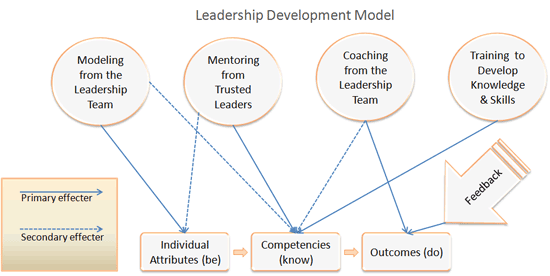
There are five effectors on the Capability Model:
- Modeling — This includes both Albert Bandura's Observational Learning in which we “learn” from observing others (not merely “imitate”) and other forms of social learning in which we learn from being situated in a common environment with others.
- Mentoring —The informal transmission of knowledge, social capital, and psychosocial support.
- Coaching — Encouraging the individual to improve both job skills and knowledge.
- Training/Development — Learning that is provided in order to improve performance on the present job and helping others to acquire new horizons, technologies, or viewpoints.
- Feedback — The learner responds in such a way as to reverse the direction of change.
Implementing the framework
During the rollout, do not get hung up with identify basic tasks, but rather competencies. A task is normally identified with a particular job, duty, or project; while a competency is a knowledge structure and/or related skill sets that will guide a person throughout a chosen career path.
For example, if a person is in the training profession, then having a good understanding of ADDIE (ISD) will help guide her throughout her career path, such as being a trainer, designer, consultant, or project manager. Within that competency, there are basic tasks or concepts that are used in particular functions of training. For example, a learning objective is normally written by a designer, while an instructor uses it as a guide to ensure the end-results are met. In addition, a good consultant might never use the term in particular situations knowing it will only confuse the present clients.
A task basicly fits in the third component of the capability model — performer outcome; while a competency, along with the attributes, allows ones to effectively perform the tasks.
NOTES
1. Adapted from: Northouse, Peter, (2004). Leadership Theory and Practice. Thousand Oaks, CA: Sage Publications.
2. The first attribute, General Cognitive Ability, is the only one that normally remains consistently stable over a person's lifetime. However, it can be compensated for by the second attribute, Crystallized Cognitive Ability.
3. The majority of organizations will have no real means to distinguish between General Cognitive Ability and Crystallized Cognitive Ability since they normally only use very rough measures to get some idea of a persons intelligence level. Thus, you might want to combine the two together for you project. Nevertheless, no matter which way you decide to go, this does gives you a place to put a person's diploma or other general cognitive abilities if your mapping project decides that they are needed.
4. One of the reasons that attributes are kept separate from competencies is that competencies are normally trained as they can be used immediately upon the learner returning to the job, while attributes normally fall under development in that while they help the learner to grow, they normally take longer to make a positive impact on the organization.