
Note: This site is moving to KnowledgeJump.com. Please reset your bookmark.
Definitions in Instructional Design
Training is everything. The peach was once a bitter almond; cauliflower is nothing but cabbage with a college education. - Mark Twain in Pudd'nhead Wilson
This section defines the most important terms of the learning, training, and performance field in depth. For other definitions, see the glossary.
Learning Defined
While there are many definitions of learning, most of them have these two common elements (Hergenhahn, 1982; DeSimone, Werner, Harris, 2002; Good, Brophy, 1990):
- it is a relatively permanent change in behavior, cognition, or effect
- it occurs as a result of study, instruction, social interactions or experience (interaction through the environment)
The definition starts with, relatively permanent change, which means that the information we remember must be retained for some time. If we only remember the information for a short time, such as finding a location on a map and then going to that location, but forgetting about it a short time later, then that was simply the use of information, not learning.
The other important part is that we can learn through almost all of our experiences, not just through school lessons or training.
Training Defined
Training is defined as learning that is provided in order to improve performance on the present job (Nadler, 1984).
This differs from a few other definitions in that rather than “training” being used as a verb — to train; it defines it from the learners' action — an activity they perform.
Performance is improved by helping the learners to master a new or established technology. The technology may be a piece of heavy machinery, a computer, a procedure for creating a product, or a method of providing a service.
Notice that the last part of the definition states that training is provided for the present job. This includes training new personnel to perform their job, introducing a new technology, or helping an employee to achieve standards.
Earlier it was stated that there are four inputs to a system: people, material, technology, and time. Training is mainly concerned with the meeting of two of these inputs: people and technology — helping people master a given technology.
Note: While we often think of technology as computers, electronics, etc., it is much more. The Merriam-Webster dictionary defines technology as the practical application of knowledge, especially in a particular area. It includes the usage and knowledge of tools, techniques, and crafts, or a system, process, or method for organization.
Human Resource Development Defined
Training is part of Human Resource Development (HRD). Do not confuse HRD with the term human resource department. A human resource department is concerned with all aspects of their employees, such as pay, benefits, equal opportunity, and training. HRD is mostly concerned with training, development, and education.
HRD is defined as an organized learning experience, conducted in a definite time period, to increase the possibility of improving job performance and growth (Nadler, 1984).

If you don't know where you are going, any road will take you there. - Lewis Carroll in Alice's Adventure in Wonderland.
Organized means that it is conducted in a systematic way. Although learning can be incidental or serendipitous, training is concerned with the worker learning clear and concise standards of performance or objectives. Objectives are the tools for guiding managers, learners, and trainers.
Managers need objectives so that they know what kind of return they are receiving from their training investment. Learners need them so that they know what is expected of them. And trainers need them to plan and conduct the learning environment so that they may help the learners achieve the desired results. This is commonly known as Formal Learning.
In addition, it is also concerned with informal learning (Nadler, 1984). informal Learning is not unorganized — it is just more individualized than formal Learning. It differs from Incidental Learning that the learner sets out and plans his or her learning, where as Incidental Learning occurs by chance.
The second part of the definition, conducted in a definite time period, means that the amount of time the learner will be away from work must be determined and specified at the onset of the training program.
The last part of the statement reads, to increase the possibility of improving job performance and growth. By possibility, it means that although an organization can provide the tools to help the learner succeed, such as training specialists, coaches, and state-of-the-art training materials and technology, the ultimate responsibility for success belongs to the learner.
Training, Development, and Education
HRD programs are normally divided into three main categories: Training, Development, and Education. Although some organizations lump all learning under “Training” or “Training and Development,” dividing it into three distinct categories makes the desired goals and objectives more meaningful and precise.
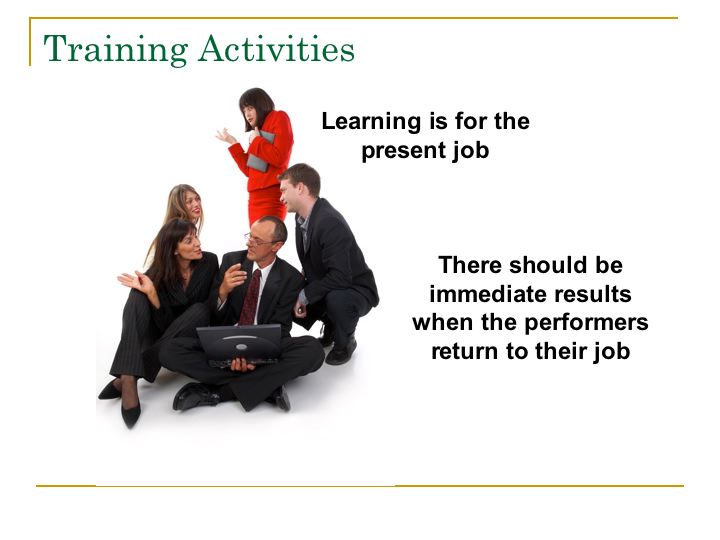

As discussed earlier, training is the acquisition of technology that permits employees to perform their present job to standards. It improves human performance on the job the employee is presently doing or is being hired to do. In addition, it is given when new technology in introduced into the workplace.
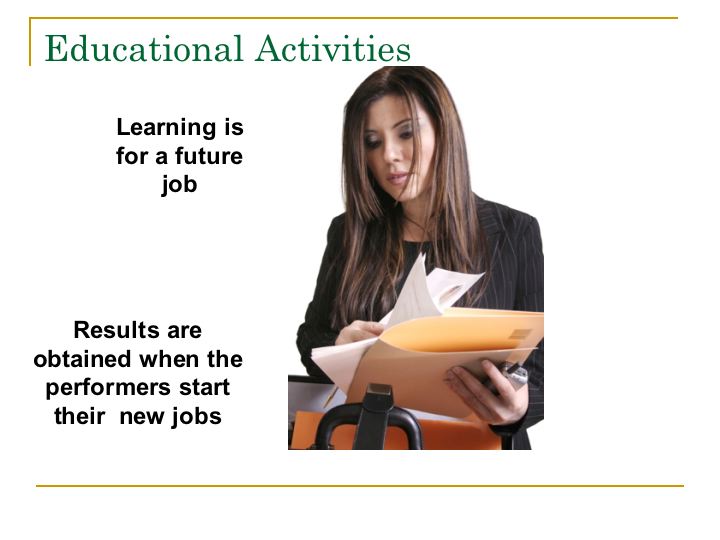
Education is helping people to do a different job. It is often given to ensure there are skilled replacements in case the regular job holder is absent, people who have been identified as being promotable, being considered for a new job either lateral or upwards, or to increase their potential. Unlike training, which can be fully evaluated immediately upon the learners returning to work, education can only be fully evaluated when the learners move on to their future jobs or tasks. We can test them on what they learned, but we cannot be fully satisfied with the evaluation until we see how well they perform in their new jobs.
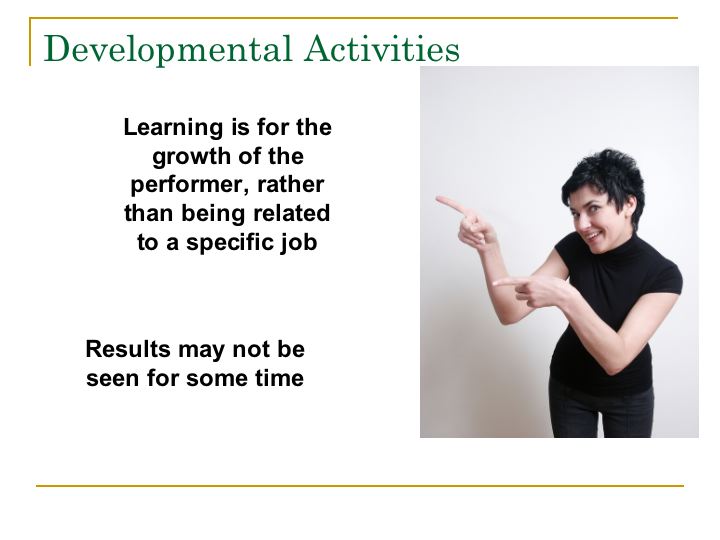
Development is helping people to acquire new horizons, technologies, or viewpoints. It enables leaders to guide their organizations onto new expectations by being proactive rather than reactive. It enables workers to create better products, faster services, and more competitive organizations. It is learning for growth of the individual, but not related to a specific present or future job. Unlike training and education, which can be fully evaluated, development cannot always be evaluated. This does not mean that we should abandon development programs, as helping people to grow and develop is what keeps an organization on the cutting edge in competitive environments. Development can be considered the forefront of what is now known as the Learning Organization.
Training includes such objectives as picking up a pallet with a forklift or performing CPR. These are activities that can be mastered by a learner in a specific time frame then be immediately transferred to the job.
Development is more long term and often needs other driving forces. For example, Starbucks offered diversity classes in its early days. You cannot really train someone to perform “diversity” in a specific time, rather the full concept and living it is developed over a longer time period. In addition, it needs other driving forces, mostly leaders who talk-the-walk AND walk-the-talk. While diversity classes give the learners the big picture and concepts, the role models give them living examples.
Knowing where your learning/training/development/education dollars are being spent allows the organization to allocate its resources more wisely.
Also, do not confuse development with change. Change refers to alterations that occur over time in the learners' internal cogitative or affective characteristics (Learner, 1986). This change may be quantitative or qualitative and it implies no directionality, encompassing both regression and progression. Development is always progressive.
ISD Defined
ISD (Instructional System Design) is the application of proven learning processes to determine the what, where, when, and how of training (U.S. Army Field Artillery School, 1984).
Using ISD to design training, education, and development processes ensure that an organization gets the most from its resources. Although this guide mainly discusses the creation of training programs, development and education programs can also be built by using an ISD approach with little or no modifications.
ADDIE Defined
While the concept of ISD has been around since the early 1950s, ADDIE first appeared in 1975 (see the ISD and the ADDIE timelines). It was created by the Center for Educational Technology at Florida State University for the U.S. Armed Forces (Branson, Rayner, Cox, Furman, King, Hannum, 1975; Watson, 1981).
ADDIE is a model that follows the ISD framework and is composed of five steps: Analysis, Design, Development, Implement, and Evaluate.
Next Steps
Next section: ISD as Design Science
Pages in the ISD Overview
-
Definitions and Explanations
Return to the Table of Contents
References
Branson, R.K., Rayner, G.T., Cox, J.L., Furman, J.P., King, F.J., Hannum, W.H. (1975). Interservice procedures for instructional systems development. (5 vols.) TRADOC Pam 350-30 NAVEDTRA 106A. Ft. Monroe, VA: U.S. Army Training and Doctrine Command, August 1975. (NTIS No. ADA 019 486 through ADA 019 490).
Good, T., Brophy, J. (1990). Educational Psychology: A realistic approach. New York: Holt, Rinehart, & Winston.
DeSimone, R.L., Werner, J.M., Harris, D.M. (2002). Human Resource Development. Orlando, FL: Harcourt, Inc.
Learner, R. (1986). Concepts and Theories of Human Development (2nd ed.). New York: Random House.
Hergenhahn, B.R. (1982). An Introduction to Theories of Learning. New York: Prentice Hall.
Nadler, L. (1984). The Handbook of Human Resource Development. New York: John Wiley & Sons.
U.S. Army Field Artillery School (1984). A System Approach To Training. ST - 5K061FD92
Watson, R. (October 1981). Instructional System Development. In a paper presented to the International Congress for Individualized Instruction. EDRS publication ED 209 239.