Note: This site is moving to KnowledgeJump.com. Please reset your bookmark.
Character and Traits in Leadership

Managers are people who do things right, while leaders are people who do the right thing. — Warren Bennis, Ph.D. On Becoming a Leader
Building Excellence
Leaders do not command excellence; they build excellence. Excellence is “being all you can be” within the bounds of doing what is right for your organization. To reach excellence you must first be a leader of good character. You must do everything you are supposed to do.
Organizations will not achieve excellence by figuring out where it wants to go, having leaders do whatever they have to in order to get the job done, and then hope their leaders act with good character. This type of thinking is backwards. Pursuing excellence should not be confused with accomplishing a job or task. When you do planning, you do it by backwards planning. However, you do not achieve excellence by backwards planning. Excellence starts with leaders of good and strong character who engage in the entire process of leadership. And the first process is being a person of honorable character.

Waste no more time arguing what a good man should be. Be one. — Marcus Aurelius
Character develops over time. Many think that much of a person's character is formed early in life. However, we do not know exactly how much or how early character develops. But, it is safe to claim that character does not change quickly. A person's observable behavior is an indication of his or her character. This behavior can be strong or weak, good or bad. A person with strong character shows drive, energy, determination, self-discipline, willpower, and nerve. She sees what she wants and goes after it. She attracts followers. On the other hand, a person with weak character shows none of these traits. She does not know what she wants. Her traits are disorganized; she vacillates and is inconsistent. She will attract no followers.
A strong person can be good or bad. A gang leader is an example of a strong person with a bad character, while an outstanding community leader is one with both strong and good characteristics. An organization needs leaders with both strong and good characteristics — people who will guide them to the future and show that they can be trusted.
Courage—not complacency—is our need today. Leadership — not salesmanship. - John F. Kennedy
To be an effective leader, your followers must have trust in you and they need to be sold on your vision. Korn-Ferry International, an executive search company, performed a survey on what organizations want from their leaders. The respondents said they wanted people who were both ethical and who convey a strong vision of the future. In any organization, a leader's actions set the pace. This behavior wins trust, loyalty, and ensures the organization's continued vitality. One of the ways to build trust is to display a good sense of character composed of beliefs, values, skills, and traits (U.S. Army Handbook, 1973):
Beliefs are the things we hold dear to us and are rooted deeply within us. They could be assumptions or convictions that you hold true regarding people, concepts, or things. They could be the beliefs about life, death, religion, what is good, what is bad, what is human nature, etc.
Values are attitudes about the worth of people, concepts, or things. For example, you might value a good car, home, friendship, personal comfort, or relatives. Values are important as they influence a person's behavior to weigh the importance of alternatives. For example, you might value friends more than privacy, while others might be the opposite.
Skills are the knowledge and abilities that a person gains throughout life. The ability to learn a new skill varies with each individual. Some skills come almost naturally, while others come only by complete devotion to study and practice.
Traits are distinguishing qualities or characteristics of a person, while character is the sum total of these traits. There are hundreds of personality traits, far too many to be discussed here. Instead, we will focus on a few that are crucial for a leader. The more of these you display as a leader, the more your followers will believe and trust in you.
Traits of a Good Leader
Compiled by the Santa Clara University and the Tom Peters Group:
-
Honesty — Display sincerity, integrity, and candor in all your actions. Deceptive behavior will not inspire trust.
-
Competent — Base your actions on reason and moral principles. Do not make decisions based on childlike emotional desires or feelings.
-
Forward-looking — Set goals and have a vision of the future. The vision must be owned throughout the organization. Effective leaders envision what they want and how to get it. They habitually pick priorities stemming from their basic values.
-
Inspiring — Display confidence in all that you do. By showing endurance in mental, physical, and spiritual stamina, you will inspire others to reach for new heights. Take charge when necessary.
-
Intelligent — Read, study, and seek challenging assignments.
-
Fair-minded — Show fair treatment to all people. Prejudice is the enemy of justice. Display empathy by being sensitive to the feelings, values, interests, and well-being of others.
-
Broad-minded — Seek out diversity.
-
Courageous — Have the perseverance to accomplish a goal, regardless of the seemingly insurmountable obstacles. Display a confident calmness when under stress.
-
Straightforward — Use sound judgment to make a good decisions at the right time.
-
Imaginative — Make timely and appropriate changes in your thinking, plans, and methods. Show creativity by thinking of new and better goals, ideas, and solutions to problems. Be innovative!
Retreat Hell! We've just got here! — Attributed to several World War I Marine Corps officers, Belleau Wood, June 1918 (key idea — take a stand)
Attributes
Attributes establish what leaders are, and every leader needs at least three of them (U.S. Army Handbook, 1973):
-
Standard-Bearers
-
establish the ethical framework within an organization. This demands a commitment to live and defend the climate and culture that you want to permeate your organization. What you set as an example will soon become the rule as unlike knowledge, ethical behavior is learned more by observing than by listening. And in fast moving situations, examples become certainty. Being a standard-bearer creates trust and openness in your employees, who in turn, fulfill your visions.
Developers
-
help others learn through teaching, training, and coaching. This creates an exciting place to work and learn. Never miss an opportunity to teach or learn something new yourself. Coaching suggests someone who cares enough to get involved by encouraging and developing others who are less experienced. Employees who work for leaders who developer them know that they can take risks, learn by making mistakes, and winning in the end.
Integrators
-
orchestrate the many activities that take place throughout an organization by providing a view of the future and the ability to obtain it. Success can only be achieved when there is a unity of effort. Integrators have a sixth sense about where problems will occur and make their presence felt during critical times. They know that their employees do their best when they are left to work within a vision-based framework.
Goddamn it, you will never get the Purple Heart hiding in a foxhole! Follow me! - Captain Henry P. “Jim” Crowe, USMC, Guadalcanal, 13 January 1943. (key idea — “follow me”, NOT “go”)
Perspectives of Traits
Traits (acronym — JJ did tie buckle)
- Justice
- Judgment
- Dependability
- Initiative
- Decisiveness
- Tact
- Integrity
- Enthusiasm
- Bearing
- Unselfishness
- Courage
- Knowledge
- Loyalty
- Endurance
The Image of Leadership — John Schoolland
What kind of a leader are you going to be — the kind who thinks he is the best?
Or will you be one of the very few greats
Who attributes success to the rest.
The U.S. Army's Eleven Leadership Principles
— Be tactically and technically proficient
— Know yourself and seek self-improvement
— Know your soldiers and look out for their welfare
— Keep your soldiers informed
— Set the example
— Ensure the task is understood, supervised and accomplished
— Train your soldiers as a team
— Make sound and timely decisions
— Develop a sense of responsibility in your subordinates
— Employ your unit in accordance with its capabilities
— Seek responsibility and take responsibility for your actions
Structure, Consideration, and Followers
Followers perceive their leaders' behavior in terms of two categories referred to as consideration and structure (Fleishman, 1953).
Leaders who have good and strong traits tend to show consideration towards others. Consideration may be defined as behavior involved in fostering effective relationships, such as showing concern for a follower or acting in a supportive manner towards others.
Initiating structure is the action of a leader who is focusing on task accomplishment, such as clarifying work roles, informing followers of the performance standards, or assigning a follower to a specific task.
These two components, structure and consideration, are the parts that make up the Leadership or Managerial Grid and are the basis for how followers act in their roles:
-
The structure gives the organization its form and dictates the way it will interact.
-
The leaders determine the ultimate effectiveness of the organization as the character (consideration) and skills (structure) they bring determines the way problems are solved and tasks are accomplished.
-
The followers respond to the structure and the leaders' consideration.
U.S. Army's 23 Traits of Character
- Bearing
- Confidence
- Courage
- Integrity
- Decisiveness
- Justice
- Endurance
- Tact
- Initiative
- Coolness
- Maturity
- Improvement
- Will
- Assertiveness
- Candor
- Sense of humor
- Competence
- Commitment
- Creativity
- Self-discipline
- Humility
- Flexibility
- Empathy/Compassion
Are managers leaders? Are leaders managers?
Managers need to be leaders. . . their workers need vision, consideration, and guidance!
Leaders need to be good managers of the resources entrusted to them!
Is Character Developed Via Nature or Nurture?
The nature vs. nurture debate is not linear enough to put percentages on it — on one side of the fence we have nature and on the other side, we have nurture. While nature (genes) certainly has its influences on us, the environment (nurture) normally determines the impact of a gene. (Ridley, 2003)
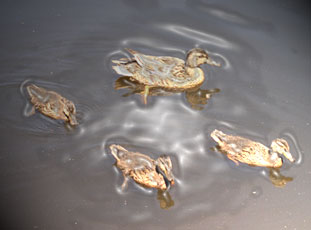
For example, one of the classic examples for discussing genes is Konrad Lorenz's work on the imprinting that occurs in baby geese — they have it within them to imprint whatever is moving near them, which is normally their mother. However, it could be anything else that is moving around them, such as a person. But no matter what they imprint on, rather it be their mother, a human, or an inanimate object, the piece of the environment that they actually imprint on is going to have a huge impact on their life. Thus, genes provide the goal, but the environment provides the process. And it is what happens during the process that will determine the outcome.
Jean Piaget was one of the first persons to study children as species equipped with a characteristic mind, rather than as apprentice adults (little adults). He discovered they went through a series of five developmental stages that were always in the same order, but not always at the same rate:
-
Sensorimotor - infants and toddlers acquire knowledge through sensory experiences and manipulating objects
-
Preoperational - learns to speak and play and pretend
-
Concrete operational - logical thinking
-
Formal Operational - Abstract Thoughts and Deductive reasoning (adolescence)
Piaget believed a gene's meaning depends heavily on its context with the surrounding environment. That is, while a child goes through four stages of development (genes), it is the active engagement of the mind with the surrounding environment (nurture) that causes development. The two main forces of the environment are feedback and social interaction. From this, the child assimilates predicted experiences and accommodates it to unexpected experiences.
For some time it was believed that animals grew no new neurons in the cortex of their brains upon reaching adulthood, thus their fate was basically sealed by their genetic nature. This was apparently proved by a Pasco Rakic, a neuroscientist. However, Fernando Nottebohm soon found that adult canaries made new neurons when they learn new songs. So Rakic replied that it was only adult mammals that could not grow neurons. But soon afterward, Elizabeth Gould found that rats grow new neurons. So Rakic replied primates could not. Gould next discovered that tree shrews grew new neurons. Rakic then stated that higher primates could not grow new neurons. Gould found them in marmosets. Rakic zeroed it down to old-world primates. Gould then discovered them in macaques.
Today it is almost certain that all primates, including humans, grow new neurons in response to new experiences, and lose neurons in response to neglect. Thus, with all the determinism built into the initial wiring of our brain, experience with our surrounding environment refines and in some cases rewires that initial wiring.
Nature may be our internal guide (map), but nurture is our explorer that has the final say in what we do and become (destination).
Deceptions in Leadership
In Clark Aldrich's book, Simulations and the Future of Learning, he tells the story of a manager who listened to the ideas presented to him by his subordinates and then went to his boss and presented them as his own. He then had the subordinates dismissed so that there were no witnesses left. I imagine that he was considered a good leader by both his boss and himself, yet the subordinates would of course had said otherwise. In most circumstances, the best judges of leadership are the followers.
I once worked with a retired Navy Chief who led one of our departments. Being located in the Pacific Northwest, the department has a good share of individuals who, let's say, have quite an opposing idea of the military. In addition, since the company provides same-sex benefits to its partners, it also attracts it share of people from the gay community. So here we have this ramrod-straight leader with perfectly combed hair, who even in civilian clothes looks as if he is still in uniform (starched, straight lines, etc.), quite conservative, and whose actions often paints the perfect picture of a Marine drill instructor. His subordinates, for the most part, have long hair, body-piercings, dress quite sloppy, are quite liberal, whose actions at times reminds you of the demonstrators you see during anti-war protests. However, they thought he was the greatest thing since the invention of peanut butter. They were in tears when he left the company to go on to greater things.
Great leadership works in the military and civilian life because it is what one “DOES.” Hitler and Aldrich's manager are deceptions who capture the essence of phoniness and are quite self-serving in nature. Gandhi and the retired Navy Chief are leaders because they capture the essence of truth and selfless service.
During Enron's heyday, its officers were discussing how much money they could screw out of Aunt Millie.
Leadership is multifaceted in that it takes a path along many dimensions and perspectives. In the early stages of the Iraq war, a senior Army officer was charged with pointing a gun at a local and threatening to shoot him if he did not reveal some information. According to the officer, he needed the information to save lives and that he would not have actually shot him. His actions were applauded by many, to include the mothers and wives of the soldiers he was sworn to protect (one of the basic rules of leadership is that you look out for the welfare of those under you). However, senior Army officials had a different outlook on the matter in that he broke the basic leadership attributes of ethics, values, and character that it expects of its leaders.
Leadership decisions often take paths that define our nation's humanity and character. . . and it is not always an easy, straight, and narrow path, but rather a multifaceted undertaking that often has no one-correct answer.
Next Steps
Next chapter: Ethos and Leadership
Learning Activity: Leadership and Character
References
Fleishman, E.A. (1953). Personnel are People. Personnel Psychology. 6(2), 205–222.
Ridley, M. (2003). Nature Via Nurture. New York: Harper Collins.
U.S. Army. (1983). Military Leadership. FM 22-100. Washington, DC: U.S. Government Printing Office.