|
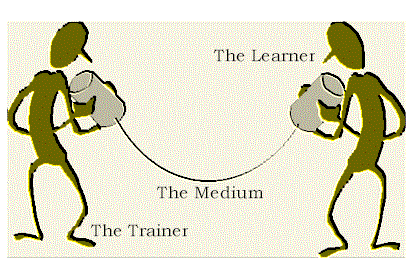
IntroductionMedia is the plural of medium, which in the training world, is the means of communicating and transferring a learning concept or objective to another individual. There are two types of training media within a training program. The first is the instructional setting or major media. For example, you might have your learners go to classroom training for 2 days. The second is the delivery systems or learning strategies. These are the various instructional methods that take place within the instructional setting. For example, in the two day class above, you might have lectures, videos, programmed instruction, coaching, etc. Other examples include a major media of coaching with learning strategies of job performance aids. Or a major media of CBT, with videos, readings, and simulations incorporated into it as the learning strategies. Training media may be grouped into four major categories:
|

A Collection of Training MediaAction LearningThis is a continuous process of learning and reflection with the intention of getting something done. Action Learning does not use project work, job rotation, or any form of a simulation such as case studies or business games. Learning is centered around the need to find a solution to a real problem. Most action learning programs take from four to nine months to complete. Learning is voluntary and learner driven, while individual development is as important as finding the solution to the problem. Five basic elements of action learning are the problem, set, client, set advisor, and process.
Active Learning (Experimental)A process of learning new ideas, skills and attitudes through what we do at work or in other behavioral situations. It is about learning from doing, performing, and taking action. Some of the methods or learning strategies it uses are:
The classes are often broke into small groups of 2 to 5 learners. Some believe groups of 3 (Triad) is the most effective for promoting interaction, while a dyad (2) promotes intimacy and sharing. Best-Of-Class Models (BOC) or Best-Of-Breed (BOB), Blended, Hybrid, or ModularThis is the goal of every great learning program, to take each learning objective on its on content, and build a medium that will best communicate and transfer it to the learners. BOCs are customized, rather than standardized. They are built by mixing various formal classes with multiple forms of self-study that is learner-centered and task focused. The trainer is more of a coach and facilitator, empowering learners to construct their own knowledge, rather than being the sole source of direction and knowledge. This type of approach also involves rapid prototyping during its implementation and dictates that learners help with the design of the program to solve their learning needs. To help with your selection, use the media selection chart and strategy guide. Boot CampAn intensive learning environment that accelerates learning (often in the high-tech arena). Boot camps have smaller classes than conventional ones with typically a dozen students or less. Applicants are screened to ensure they have a certain level of knowledge of the subject area, so that other learners are not slowed down in the rapid learning environment. Boot camps are held away from the learner's work environment so there will not be any distractions, normally run from one to two weeks, and immerse learners in one subject for 12 to 16 hours a day to prepare them for a certification test. The advantage of this type of training is companies get an up-and-running employee back within a short period of time. While the disadvantages include that learners will lose their newly acquired skills if they are not used right away due to the rapid pace in which they were acquired, and some learners like the slower pace of traditional learning programs. Classroom (Conventional) (Resident Instruction)This is used when a large group must be taught the same thing at the same time or the task difficulty requires formal training. Before selecting this type of instruction, ensure that it cannot be taught effectively in another manner due to its high cost. If possible, the instructors that will be teaching the program should help with the development process. This tends to lower the development cost and the initial implementation cost. All lessons should be fully outlined. Conventional classes can run from a couple of hours to a couple of weeks. Many tend to be large, with 20 to 40 learners, who have varying levels of knowledge and skills. This type of training provides human interaction. If the class is not too large, then the trainer may determine the learners' needs so the instruction can be adapted and adjusted accordingly. The advantages are classroom setting permits the use of a wide variety of training methods, e.g. video, lecture, simulation; discussion. Also, the environment can be controlled to create a climate conducive to learning and classrooms can accommodate a large number of learners. The main limitations may involve increased costs, e.g. space rental, travel and the classroom may be quite dissimilar to the job setting. If this type of training is required you have two options. The first is In-House Training where company trainers perform the instruction, either on-site or at another location. The second option is Contract Training, where the trainers are contracted to perform the training at your location, their location, or a separate training site. The two main factors that must be considered when deciding upon In-House or Contract training are: who has the technical expertise to provide the instruction and who can provide the best training at the lowest cost? You must also decide if it will be lock-step or self-paced. In lock-step instruction everyone proceeds at the same pace, where as self-paced instruction allows the learners to proceed at their own pace. CoachingA supervisor, co-worker, peer or other outside consultant examines employee performance and provides guidance, feedback, and direction to assure a successful grasp of skills and task completion. A coach can be thought as a one-on-one trainer. Also, the main difference between a coach and a trainer, is that coaching is done in real time. That is, it is performed on the job. The coach uses real tasks and problems to help the learner increase his or her performance. While in training, examples are used within the classroom (the task or problems may be based upon real ones however). Computer Based Training (CBT) or Computer Aided Instruction (CAI)CBT provides immediately feedback to the learner and presents various levels of multimedia material until the learner reaches mastery. It is also self-paced and can be delivered to the learner's desk. Some disadvantages are some learners find it difficult to work with a computer for long periods of time as they thrive on human interaction. Also, CBT has an extremely long development times due to the complexity of the instruction, although this is beginning to decrease with better authoring tools.
Games, drills, and simulations can be produced. Games are educational activities presented in a game format. Drills provide practice of materials already learned, in order to strengthen rote knowledge. A simulation models a real situation in which the learner accomplishes a real task. This type of instruction is generally more expensive to produce, but if it can be used for an extended period, then the cost is greatly reduced as instructors are not needed, travel is eliminated, and the training material can be reused. It should not be used for rapidly evolving technologies as the technology will often change during the long development time of the courseware. e-learning or Internet Distance Learning (IDL) (Intranet, Online, Networked, Enterprise, or Web)This form of learning has emerged as a cost effective vehicle for reaching learners remotely. IDL is composed of organizational computer networks that use the Internet, World Wide Web technology, and software for finding, managing, creating, and distributing information. Its main limitations are network bandwidth (size of network's transmittal capacity), and the requirement for each learner to be connected. This type of media is starting to become a favorite with organizations that have workforces in multiple locations and only require simple learning materials. More complex training requirements will have longer development times as it basically turns into CBT training development. For more info, see e-Learning Job Performance Aid (JPA)Includes technical manuals, decals, flowcharts, or other means of listing the steps for performing a task. Computer Based JPAs include Electronic Performance Support Systems (EPSS), wizards, and Help Systems. Web Based EPSSs can be instantly updated, unlike a technical manual that must be printed, copied, and shipped to all the locations where it is used. Do not use if the task requires high psychomotor skills or if the worker lacks the prerequisite skills.
When developing material, color can often be used for instructional impact. The following chart lists some colors with their associations and emotional responses.
Often, color is used more for enhancing the looks of instructional courseware rather than enhancing the instructional material itself. For example, one author of a computer aided instructional reading program (Pournelle 1993) that will teach just about anyone from the age four and up to read English is updating the program from monochrome to color. Why? Not that it will aid in the instruction, as it as already been proven to be highly effective, but because they think it needs a face lift to help sales. The point is, if you have the resources, provide some color to make it look better. But don't think that a colorful piece of courseware is more effective than a black and white one unless the color is effectively used to highlight a teaching point. Although color is nice and can aid in the visual impact, the most import part of a job performance aid is readability. The text has to be clear, concise, and geared towards the educational level of the worker it is designed for. After you have completed the design, don't rush it off to the printers and get a hundred copies made. First, have subject matter experts proofread it for accuracy and then test it to ensure the proposed learners can understand it. It should also be reviewed by editors for the correct usage of grammar. If it is a decal, make a facsimile of it. Then paste it on the location where it will be used to ensure it fits. Now observe some workers trying to use it. Is it in the best location to be readily used? Can they read it and understand it? Have a SME also observe the workers to ensure the directions they are following are correct, complete, and in the correct sequence. If it is going to be posted in more than one location, especially if it is going on equipment, then ensure it will also fit in the other locations. Often new equipment is purchased at different times due to expansions or replacements. Just because the job performance aid fits on a certain location on one piece of equipment, doesn't mean it will also fit on the others. Just-In-Time TrainingProviding training when it is actually needed, rather than on a deferred basis. It can be automated, such as web based; or having coaches on stand-by for such needs. LectureAlthough this is the most popular way to present information since it is easy to design and implement, it can also be one of the worst methods as it is lockstep, passive, and auditory in nature. This method varies from presenting a discourse (extended speech) on a subject to an exchange of ideas. Always provide plenty of activities to help your learners grasp and understand the subject. When used correctly, lectures can set the stage for deeper learning to take place.
One method that trainers have devised to keep from calling their training a lecture, is to have the learners take turns reading from an handout. Although they call it a discussion, it is still a lecture; the only difference is that now you have the learners lecturing from a canned script. Many learners find this type of training confusing as their comprehension, reading, and listening rates are all quite different. Since the material is in a handout, you would be better off by changing it into a self-study program which meets individual needs. If needed, you can then hold a discussion period to highlight, expand, discuss, and ask for questions. In order for a learning program to be called a discussion, there must be some pre-learning so that an intelligent discussion can take place. Lockstep InstructionAll the learners proceed at the same pace. It requires fewer instructors and is more easily managed than self-paced instruction. It is often the medium of choice for one-shot training sessions. The main disadvantage is that the pace is set for average learners...but, there are no average learners to be found. Also, it is hard to meet individual learning requirements and styles. MentoringA growing segment which can be offered in person or via E-mail. A mentor is a person who cares about you and goes out of her way to see that you get the best possible chance to fulfill your career potential. It involves teaching, coaching, and helping to build a high degree of confidence. But what brings out the full magic of mentorship is some degree of affection or warm friendship...what a older brother might feel for his kid sister. Traditionally, a senior employee such as a manager, is paired with a more junior employee to prepare him or her for increasing responsibility. But the number of senior employees are limited so another method has been devised. If the employee has identified certain skills to be improved, then a Special Project Mentor (SPM) can be assigned. A SPM should not only be an expert with the desired skills, but also someone who enjoys coaching and teaching their special skills. Pointers on being a mentor:
Vendor (Out-of-House or Providers)Out of house service providers allow organizations to train their people without making a large investment in the design and development of a program. This type of training also allows them to bring in a variety of specialized trainers. Community colleges are becoming one of the largest segments of the training-provider industry, often discounting courses as part of an economic development strategy to attract or retain local businesses. On-The-Job-Training (OJT)This takes place in normal work settings. Although OJT can be an excellent training device, some training activities see OJT as a quick and easy way to get a training problem off their hands. They look at the problem for a short period of time and then tell the activity that has the training requirement, "Train them the best you can and if you have any problems come see us." The design, development, and implementation of OJT material needs the same care and attention as any other training courseware. Advantages: Facilitates transfer of learning as the learner has immediate opportunity to practice and reduces training costs because no training facilities are needed Limitations: The job site may have physical constraints and distractions that could inhibit learning and using expensive equipment for training can result in costly damage and disruption of production schedules. The supervisors or OJT coaches must know the training material, have easy access to the training material, and know the procedures for providing On-The-Job Training. You may have to provide them with some instruction in On-The-Job Training Methods. In some cases you might want to use instructors in the initial instruction, and then hand the learners over to the supervisors or coaches. Personalized System of Instruction (PSI)Dr. Fred Keller introduced PSI. It is similar to text instruction, but has the following characteristics: Lectures are given infrequently and only for inspirational purposes. The course is divided into small units. For each unit the learner gets a study guide that tells the learner what to read and what they must know. After reading the text they answer a set of study questions. The units are small enough so that most can complete the reading and answer the questions in a couple of hours. Other forms of training, such as CBT, activities, etc. may also be used. The learner then takes a unit test. A proctor scores the test and goes over the results, providing feedback and probing to see if the learner really understands the material. The learner must score at least a 90 percent before moving on to the next unit. There is no penalty for flunking a unit test. Those that do are coached, given relevant learning assignments, and then retested until they can pass. Once all units have been passed, then the learner graduates from the course. Programmed LearningAlthough Sidney Pressey (1927) originated programmed learning, B. F. Skinner (1958) popularized it. Skinner's approach has been called linear and involves the following features:
Branching programmed learning is similar to linear programmed learning except that it is more complicated, since it attempts to diagnose the learner's response. It usually involves a multi-choice format.
After the learners have been presented a certain amount of information, they are given a multiple-choice question. If they answer correctly they branch to the next body of information. If they are incorrect, they are directed to additional information, depending on the mistake they made. Many CBT training courses are based on the concept of linear or branching programmed learning. Programmed learning has been proven to be effective (Schramm, 1964). A review of 165 studies of programmed learning was made. Of 36 studies that compared programmed learning with the more traditional kinds of training, 17 found programmed instruction to be more effective, 18 found both kinds of instruction to be equally effective, and only one found traditional training to be more effective. Appendix F, Training Programs, shows an example of a programmed learning courseware. Self Learning Package (Self Teaching Package)Although the initial development time is generally greater than for resident instruction, they are usually cheaper over the long run if they can be used for an extended period of time. They include CBT, Text Instruction, Personalized System of Instruction, and Programmed Learning. Since learning is an individual phenomenon and not a group phenomenon, this method allows the learners to proceed at their own pace. The main disadvantage is that the learners must be motivated to learn on their own. This type of training is suitable if close supervision is not required and the task can be learned by individuals or a group. Never use this type of courseware if task failure may result in injury or damage. Self-Paced InstructionSelf pace is generally better in most learning situations as it allows each learner to proceed at his or her own pace. It is more difficult to develop as it cannot ad-lib its way through the subject as a good trainer can. Also, it is more difficult to manage than lockstep. Most of the time it is cheaper than classroom training, but sometimes requires more instructors or smaller class sizes because of the wide range of variables that take place within the learning environment. TelecommunicationInstructional television (ITV) links several locations for instructional and conference purposes between remote locations via telecommunication technology. Satellites can cut travel expenses and beam the training to thousands of locations. Text InstructionA learner is assigned reading material to study. The reading material may be technical manuals, books, or courseware produced by the training activity. Self-tests should also be included throughout the training material. Classes and evaluations may also be part of the training material. The learners should always be given a mentor or coach to consult in case they have difficulties with any of the reading assignments. The mentor should hold discussions with their assigned learner on a regular basis. WorkbookSimilar to Text Instruction, except the reading material has activities and exercises to reinforce the learning concepts. VideoThe most common form is video tapes, with most of them being provided by outside vendors, followed by 35mm films. This also includes a vignette or a short visual used to present a problem for solving or discussing. Another source of videos is to use movies (video tapes) that help to bring the subject to real life. |

ReferencesJerry Pournelle (1993, August). BASIC Instinct. Byte, pp.209 - 218. Return Pressey, S. L. (1927). A Machine for Automatic Teaching of Drill Material. School and Society, 25, p.p. 549-52. Return Skinner, B. F. (1958). Teaching Machines. Science, 128, p.p. 969-77. Return Schramm, W. (1964). The research on Programmed Instruction: An Annotated Bibliography. Washington D.C.: U.S. Office of Education (OE-34034), 1964. Return |

| Notes
Updated June 1, 1999. Updated January 26, 2001. |