

Note: This site is moving to KnowledgeJump.com. Please reset your bookmark.
van Merriënboer's 4C/ID Model and Instructional Design
“4C” means “four components”, while “ID” means “Instructional Design.” During the design phase the tasks to be learned are ordered sequentially according to task difficulty and then scaffolds are added that support the learner's in their quest to gain new knowledge and skills.
The learning methods consists of complex problem solving coupled with completing procedures that match authentic set of tasks. When it comes to delivery or implementation, the tasks are practiced and performed by the learners in real or simulated environments, while the level of support diminishes as the learner progresses. Task complexity also increases within each level as the learners progress; however, each level of complexity adds additional supportive information. This learning platform allows the learners to navigate the increasingly complex learning environment by being supported by just-in-time external support; in addition to the learners own increasing skill-set.
Merriënboer, Clark, and Croock (2002) wrote that the 4C/ID-model, “addresses at least three deficits in previous instructional design models. First, the 4C/ID-model focuses on the integration and coordinated performance of task-specific constituent skills rather than on knowledge types, context or presentation-delivery media. Second, the model makes a critical distinction between supportive information and required just-in-time (JIT) information (the latter specifies the performance required, not only the type of knowledge required). And third, traditional models use either part-task or whole-task practice; the 4C/ID model recommends a mixture where part-task practice supports very complex, whole-task learning."
The Four-Component Instructional Design model or 4C/ID-model working assumption is that complex learning platforms can be described by four basic components (van Merriënboer, Clark, et al., 2002), which in turn creates a blueprint for the design of the learning platform:
The Four Components
- Learning Tasks — concrete, authentic, whole task experiences that are provided to learners in order to promote schema construction for non-recurrent aspects and, to a certain degree, rule automation by compilation for recurrent aspects. Instructional methods primarily aim at induction, that is, constructing schemata through mindful abstraction from the concrete experiences that are provided by the learning tasks. Design steps:
- Design learning tasks
- Sequence task practice
- Set performance objectives
- Supportive Information — information that is supportive to the learning and performance
of non-recurrent aspects of learning tasks. It provides the bridge between learners' prior
knowledge and the learning tasks. Instructional methods primarily aim at elaboration, that is, embellishing schemata by establishing nonarbitrary relationships between new elements and what learners already know. Design steps:
- Design supportive information
- Analyze cognitive strategies
- Analyze mental models
- JIT Information — information that is prerequisite to the learning and performance of
recurrent aspects of learning tasks. Instructional methods primarily aim at compilation
through restricted encoding, that is, embedding procedural information in rules. JIT information is not only relevant to learning tasks but also to Part-time practice. Design steps:
- Design procedural information
- Analyze cognitive rules
- Analyze prerequisite knowledge
- Part-task Practice — practice items that are provided to learners in order to promote rule
automation for selected recurrent aspects of the whole complex skill. Instructional methods primarily aim at rule automation, including compilation and subsequent strengthening to reach a very high level of automatically. Design step:
- Design part-task practice
Approaches to Presenting Information and Examples
When presenting content, two approaches can be used:
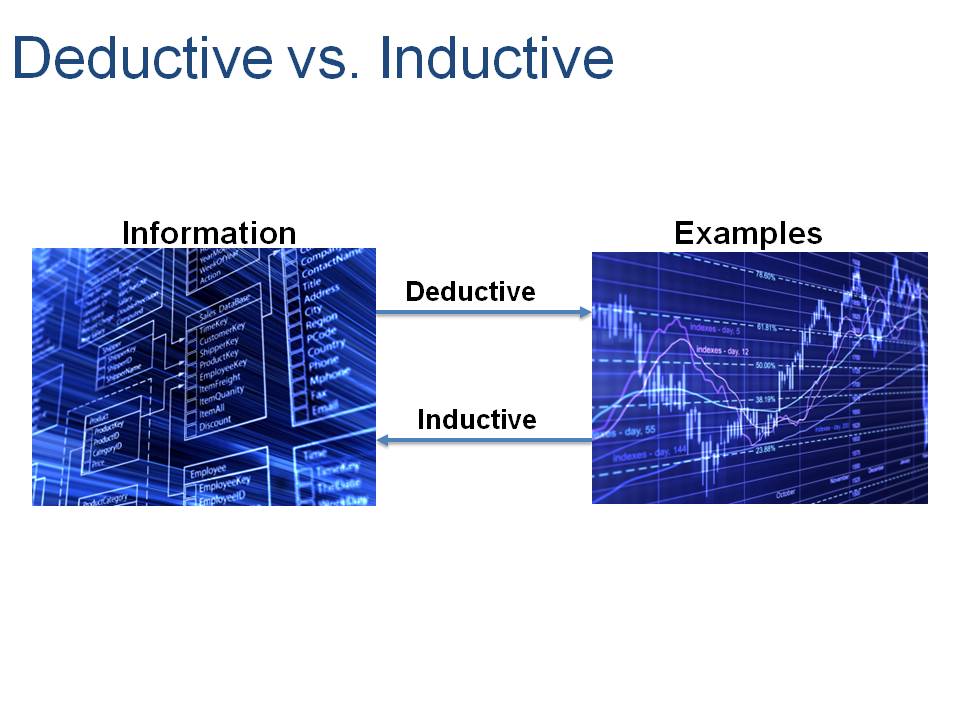
- A deductive approach works by presenting the general information, followed by examples.
- An inductive approach works in the opposite direction by first presenting the examples to the learners, and then giving them the general information.
Closely related to the presentation methods are two strategies for helping the learners to learn:
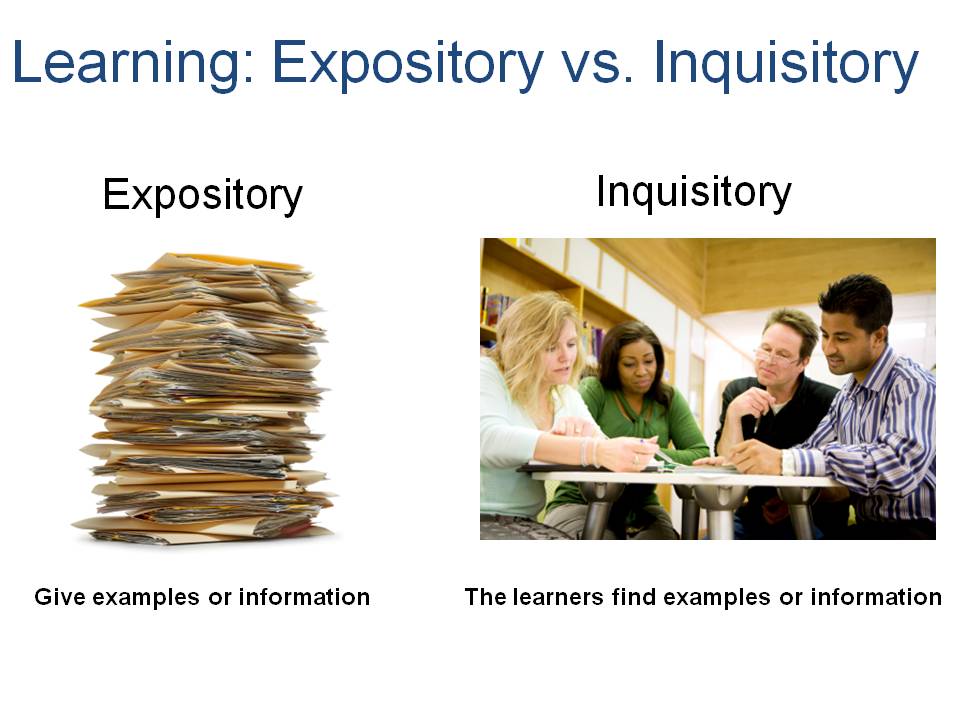
- Expository learning, which is presenting examples and information
- Inquisitory learning, in which the learners find examples or general information
The two approaches for presenting content and the two learning strategies gives us four instructional design methods:
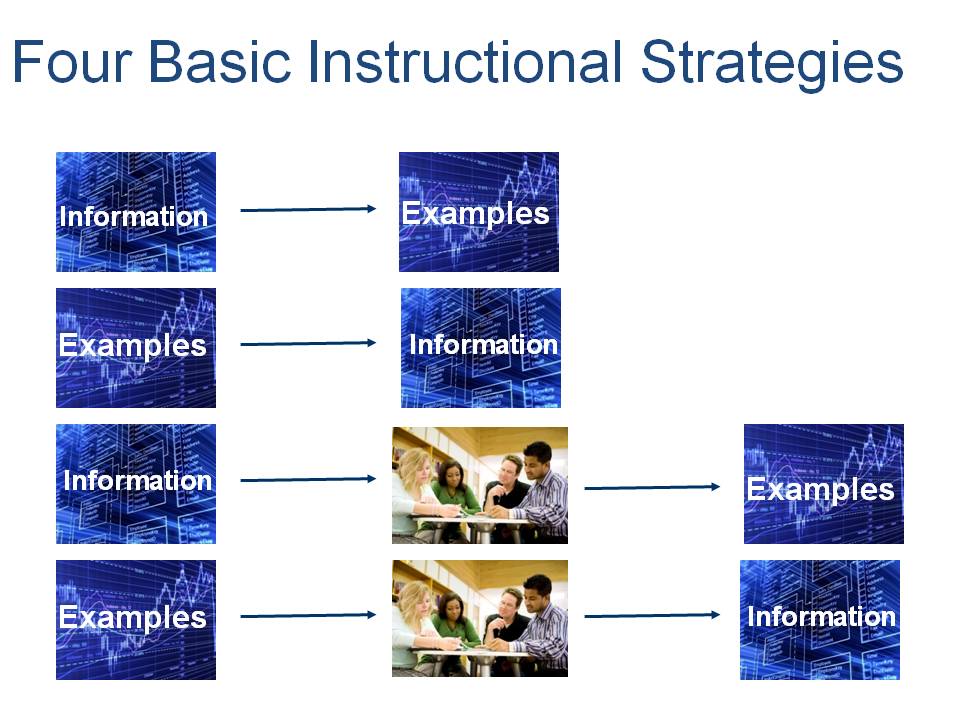
Present the:
- information first and then the examples.
- examples first and then the information.
- information and then have the learners find or produce examples.
- examples and then have the learners find or produce the information.
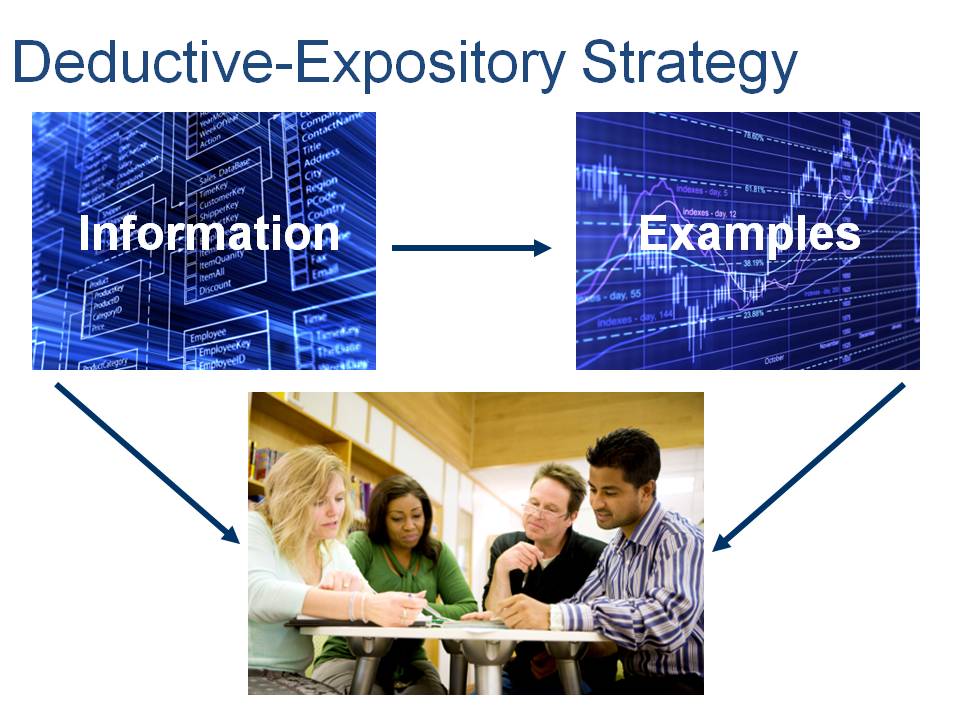
A deductive-expository strategy works by first presenting information and then the examples. Thus, all the content is presented to the learners. For example, you present the information and then a case study that illustrates the information. It is normally the most time and cost effective of the four methods.
It is best used if they have some experiences with concrete examples or cases that enable them to understand the general information and a deep level of understanding is not required. It works for simple declarative knowledge, such as facts and simple concepts and models.
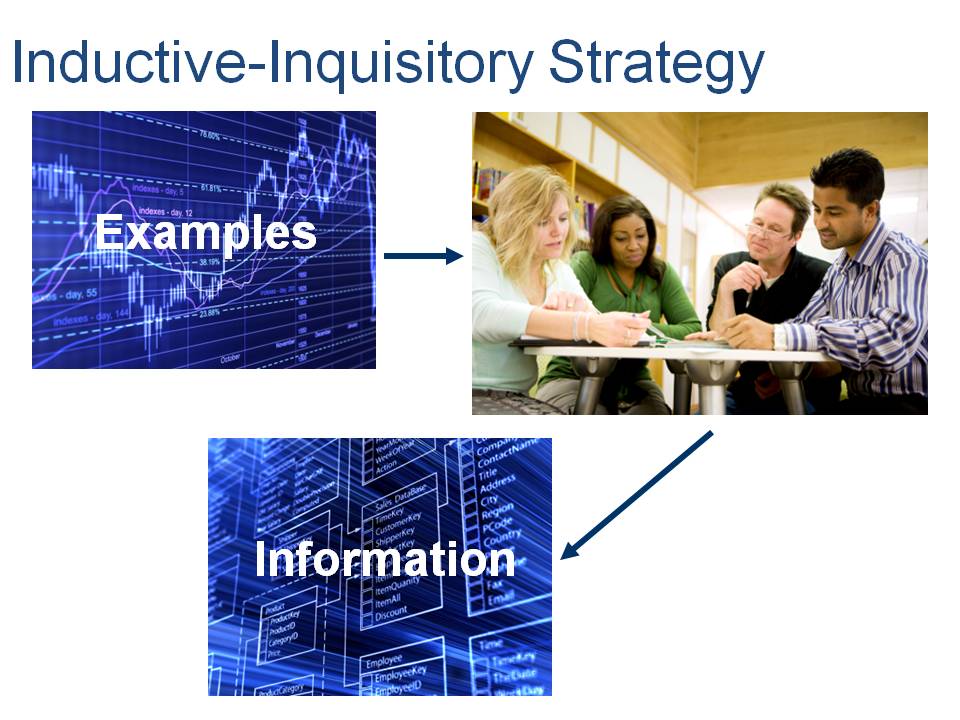
The inductive-inquisitory strategy works by presenting examples and then the learners produce the information. Thus, rather than just receiving the content, they now receive and produce. For example, you present a case study and then the learners provide the general information about the case study.
This method works best when the learners have little or no experience with concrete examples or cases and their knowledge consists mostly of:
- simple or naive strategies
- simple or naive models
It is normally a time consuming strategy; however, it is probably one of the best method for reaching a deep level of understanding. To reduce the amount of time it takes, use some “leading questions,” which makes it a guided discovery learning method rather than strictly exploratory.
This method works best with strategic knowledge, such as heuristics and systematic approaches to problem solving.

An inductive-expository strategy works by first presenting examples and then the information. And again, all the content is presented to the learners. For example you present a case study and then the information.
This method normally provides the learners with a deeper understanding than the deductive-expository method, but is not as good as the inductive-inquisitory method, thus it provides a middle-of-the-road method.
This also works best for simple declarative knowledge, such as facts and simple concepts and models.
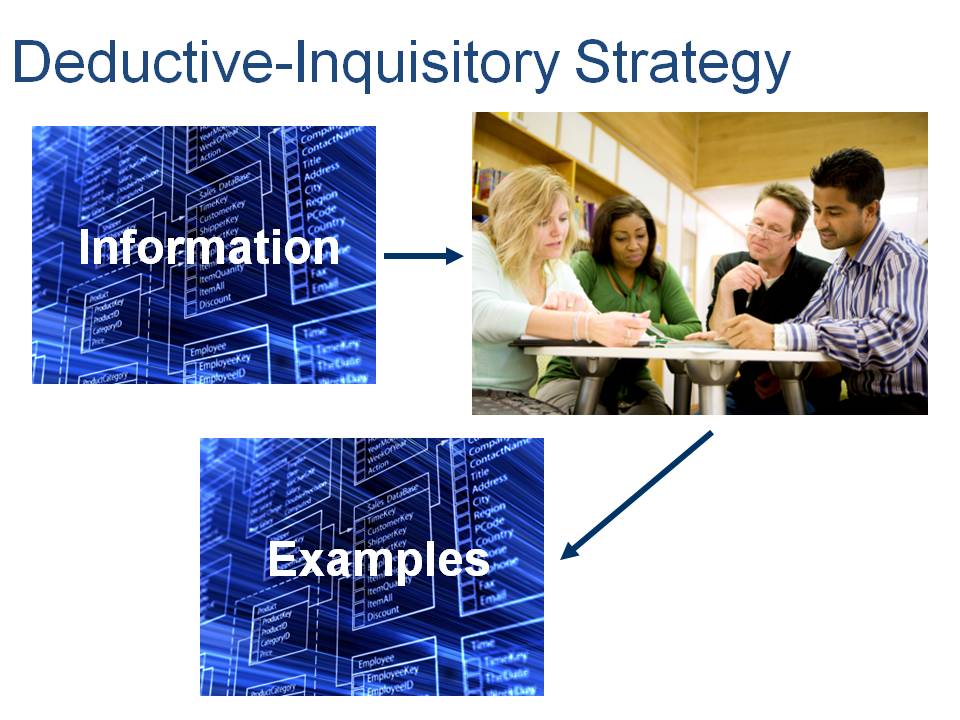
The deductive-inquisitory strategy works by presenting the information to the learners and then they produce some examples. For example, you present the information and then they come up with a case study or model.
This strategy fits in with whole-task practice in complicated tasks that have many parts. That is, once the learners have used the other three methods for learning the parts of a task, use this method to bring the whole task together.
This method also works best with strategic knowledge, such as heuristics and systematic approaches to problem solving.
References
van Merriënboer, J. J. G. (1997). Training Complex Cognitive Skills: A Four-Component Instructional Design Model for Technical Training. Englewood Cliffs, New Jersey: Educational Technology Publications.
van Merriënboer, J. J. G., Clark, R. E., de Croock, M. B. M. (2002) Blueprints for complex learning: The 4C/ID-model. Educational Technology, Research and Development, 50 (2);39-64, DOI: 0.1007/BF02504993