
Note: This site is moving to KnowledgeJump.com. Please reset your bookmark.
Saettler's History of Instructional Technology - 1968
In the present book, we have been serving primarily as reporters, but also as interpreters (no human report can be absolutely objective) and critics. With the possible exception of programmed instruction, all of the historical instructional approaches presented so far in part 2 fall short of truly scientific technology of instruction. In contrast, the systems approach to instruction offers a conceptual framework which, hopefully, can provide a model for the achievement of this ideal. Since we are merely on the frontier of this development, much of this chapter will necessarily depart from the retrospective treatment of previous chapters and will focus instead on prospective developments. - Paul Saettler (1968)
In the late 1960's Paul Saettler broadly outlines instructional system design as having three components: 1) Design, 2) Development, and 3) Operation and Evaluation.
The Design component is summarized as having “where, when, with what, and whom you must accomplish what, for whom, and where.” Thus it begins with a specification of goals or purposes for the system. After the purpose has been stated, then the nature of the learners are described, requirements, etc. Thus, the design component not only includes the design, but also the analysis.
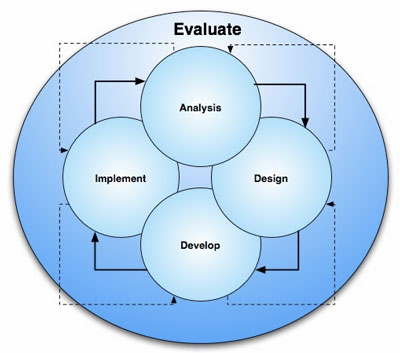
The Development component remains basically the same, while the Operation and Evaluation component notes that operation is the implementation or delivery of the learning process and testing being the evaluation. So in a nutshell, the five phases of ADDIE or ISD that we now know have been compiled into three parts.
Next Steps
Next section: George Odiorne - A System Approach to Training
Return to the History of Instructional System Design
References
Saettler, Paul (1968). History of Instructional Technology. New York: McGraw-Hill.
Saettler, Paul (1990). The Evolution of American Educational Technology. Englewood, Colorado: Libraries Unlimited, Inc.