
Note: This site is moving to KnowledgeJump.com. Please reset your bookmark.
Robert Glaser - Instructional Systems - 1962
Robert Glaser describes an instructional system in 1962 (p.1-30) that is comprised of five components:
- Instructional Goals (system objectives)
- Entering Behavior (system input)
- Instructional Procedures (system operator)
- Performance Assessments (output monitor).
- Research and Development Logistics (analysis and evaluation)
The chart below maps the flow of them:
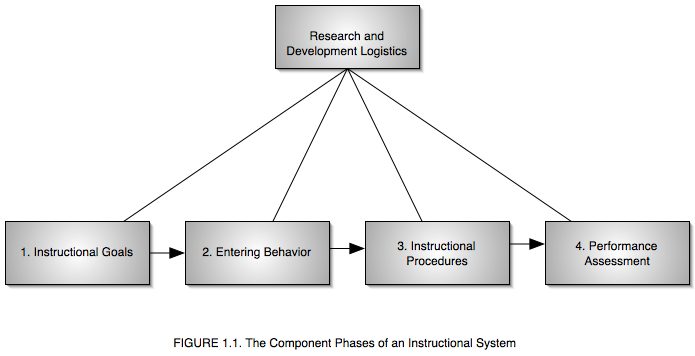
Glaser discusses the bottom four components (p.5-6):
“The development of the system is initiated with the specification of the goals of instruction. These goals constitute the objective to be accomplished and the purpose for which the system is to be designed. The main input into the system, upon which it is designed to operate, consists of the entering behavior of the student. This consists of the initial repertoire, aptitudes, and prior educational background with which the instructional process begins. The next phase constitutes the actual instructional procedures and experiences which are employed to guide and modify behavior.”
He then discusses how the four components feed into Research and Development Logistics, and in turn, how it feeds back into the four components:
“The final phase in an instructional situation is some sort of “quality control,” that is, assessment of the extent to which the end-of-course behavior has been achieved by he student in light of the kind of performance required by the specified instructional goals. These phases are the main flow of the instructional system, but it has many feedback loops and subsidiary inputs. The information obtained in each phase supplies data which are useful for monitoring and correcting the output of the preceding phase; for example, measurement of the kind of performance achieved can provide information for redesign of instructional procedures, and information on instructional procedures can interact with the characteristics of the entering behavior. Feeding in to all phases are the results of research and development. The implementation of these results and the fruitful interplay between research and development, on the one hand, and the operating aspects of the system, on the other, involve important logistical considerations.”
It is interesting that although the book was published in 1962, the same year Robert Mager published his Preparing Instructional Objectives, he describes the obtainment of “terminal behavior,” which is defined as the performance that the learner should display at the end of a specific instructional situation (p.7). Thus, both authors had the idea of performance objectives at roughly the same time, although they used different terms.
Another interesting aspect is Glaser's distinction between learning and teaching, for he writes how the Zeitgeist of the times are bridging the “science of learning” and the “art of teaching” (p.2). This is important as while a teaching system may be quite linear, the very dynamics of learning must be quite flexible in order to support the needs of the learner.
Glaser also discuses the difference between training and education and how they affect learning outcomes (p4-5):
- Training: The end-products of learning can be specified in terms of particular instances of student performance (precision of behavioral end-products are specified. This implies a certain level of uniformity.
- Education: The end-produce behaviors cannot be specified precisely because they are too complex. Maximize individual differences.
What is quite interesting about his instructional system is that even though it is one of the first ones, it has a very dynamic, rather than linear look and feel to it. For rather than being a step-by-step model, it feeds and nourishes both forward and backwards. In addition, it loses any linearity with the research and development activities being directed at each phase.
Next Steps
Next Section: The Air Force's Five Step Approach
Return to the History of Instructional System Design
Reference
Glaser, R. (1962). Psychology and Instructional Technology. Training Research and Education. Glaser, R. (ed). Pittsburgh: University of Pittsburgh Press.
Notes
It is interesting to note that of the many references that Glaser cites, two of them are:
Bloom, B.S. (Ed.) (1956). Taxonomy of Educational Objectives. New York: Longmans, Green.
Skinner, B F. (1959). Teaching Machines. In A. A. Lumsdine & R. Glaser (Ed.) Teaching Machines and Programmed Learning. Washington, D.C.: National Education Association. Pp. 137-158.