
Note: This site is moving to KnowledgeJump.com. Please reset your bookmark.
Learning to Identify Performance Problems

Objective: Although there are several solutions to a performance problem, it is only by getting to the root problem that a solution can be devised. The Performance Analysis Quadrant, shown below, is one tool for identifying the root cause.
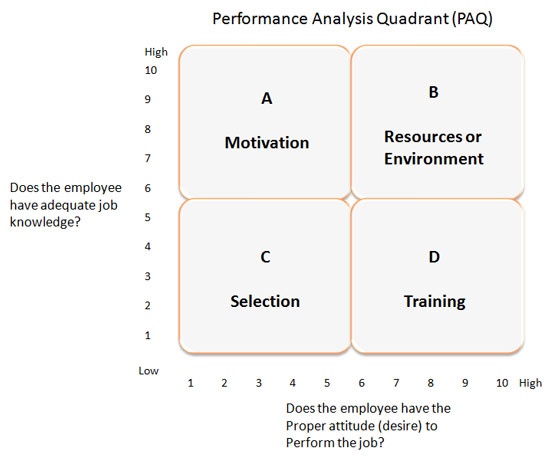
Note: The four quadrants are based on Jones' (1993) description of the four factors that affects job performance.
Have the learners perform the activity below (Knowing vs. Doing) and then discuss the following questions:
- How does the definition of a performance problem affect the general strategy for solving it? (Hint — see the four quadrants)
- Considering the employee performance problems in your company, is there a pattern to the form they take? (Hint — most are normally in Quadrant B)
- What implications does this model have for the role of a supervisor as a problem-solver?
Knowing vs Doing
Procedure: Direct the learners to draw a mental image of an employee they know who is not performing adequately. With their knowledge of the facts available, ask them to select an intersection point in the Performance Analysis Matrix that best portrays their answers to the two questions on the vertical and horizontal axes dealing with knowledge and attitude. Discuss answers and then explain how such analysis might provide clues to the four different solutions:
- Quadrant A: If the employee has sufficient job knowledge but has an improper attitude, this may be classed as motivational problem. The consequences (rewards) of the person's behavior will have to be adjusted.
- Quadrant B: If the employee has both job knowledge and a favorable attitude, but performance is unsatisfactory, then the problem may be out of control of the employee. i.e. lacking resources, bad process, time pressures. An environmental analysis is called for.
- Quadrant C: If the employee lacks both job knowledge and a favorable attitude, that person may be improperly placed in the position. This may imply a problem with employee selection, and suggest that transfer or discharge should be considered.
- Quadrant D: If the employee desires to perform, but lacks the requisite job knowledge or skills, then additional training may be the answer.
Basic Reasons Why Employees Do Not Perform Well
Lack of Skills: This is mainly an employer responsibility — the need to supply training or learning opportunities. Use when:
- Never had training
- Needs practice
- Know about the skill, but can't apply
Lack of Information: This is also an employer responsibility — need to supply information or train how to use or collect readily available information.
- Does not know expectations
- Does not have current data
- Cannot apply information
Motivational Issues: Employer and employee jointly responsible — requires mutual discussion.
- Things and people that make work punishing (feels they are working in a hostile environment)
- Personal attitudes and issues
Personal Issues: Employee responsibility — needs to take charge of life
- Substance abuse
- Emotional health
- Physical health
- Lifestyle
Environmental Issues: Employer Responsibility — redesign is needed.
- Unrealistic standards
- Poor work station design
- Inadequate tools available
- Process needs improved
Next Steps
This activity is used in conjunction with the chapter on Leadership and Motivation
Return to the Leadership Training and Development Outline
Reference
Jones, B. (1993). The four domains affecting job performance. Internal Document, Delta Air Lines. Moving from Theory to Practice: Integrating Human Factors into an Organization, Mancuso, V. (1995). Seattle, WA: Annual Flight Safety Foundation Conference. Retrieved from http://www.crm-devel.org/ftp/mancuso.pdf