
Note: This site is moving to KnowledgeJump.com. Please reset your bookmark.
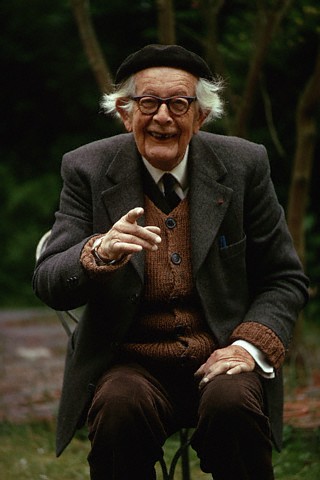
Jean Piaget (1896-1980)
Jean Piaget was a Swiss psychologist, whose development theories have been widely discussed in both psychology and educational fields. To learn, Piaget stressed the holistic approach. A child constructs understanding through many channels: reading, listening, exploring, and experiencing his or her environment.
A Piagetian-inspired curricula emphasizes a child-centered educational philosophy. His work has been labeled an interactionist as well as a constructivist. His interest in cognitive development came from his training in the natural sciences and his interest in epistemology. He saw cognitive growth as an extension of biological growth and as being governed by the same laws and principles. He argued that intellectual development controlled every other aspect of development - emotional, social, and moral.
Piaget may be best known for his four stages of cognitive development model. He discovered that children think and reason differently at different periods in their lives. He believed that everyone passed through an invariant sequence of four qualitatively distinct stages. Invariant means that a person cannot skip stages or reorder them. Although every normal child passes through the stages in exactly the same order, there is some variability in the ages at which children attain each stage. The four stages are:
- Sensorimotor (birth to 2 years) - The mental structures are mainly concerned with the mastery of concrete objects.
- Preoperational (2 years to 7 years) - The mastery of symbols takes place.
- Concrete (7 years to 11 years) - Children learn mastery of classes, relations, and numbers and how to reason.
- Formal Operation (abstract thinking) (11 years and up) - The last stage deals with the mastery of thought.
However, his four stages have not often held up well. Donald Clark lists several of the reasons in a blog post, Piaget — why teach this stuff? Note that he tends to get a bit overly-aggressive in his comments, but the posting is still a good read. I have listed some of his highlights below:
- Sensorimotor Stage - When his experiment, in which he hid a toy under a cloth and the child thinks it's no longer there, was repeated by Bower and Wishart (1972), they did it without an adult, who can be a distraction, and discovered that most children had no difficulty in understanding that the toy is still under the cloth.
- Preoperational Stage - His experiment, in which a child fails to recognize a doll’s point of view from photographs of three mountains, was conducted by by Hughes. However, he simplified the study by only using two dolls and showed that many children can understand non-egocentric perspectives.
- Concrete Stage - Rose and Blank (1974) found that Piaget had been verbally correcting the children towards his wanted conclusions, thus invalidating the data.
- Formal Operative Stage - He focused to much on formal logic, as we now come to know that there are many other ways for developing mature cognitive skills.
References
Berger, K. S. (1988). The Developing Person Through the Life Span (2nd ed.). New York: Worth Publishers Ltd.
Bower, T. G. R., & Wishart, J. G. (1972). The effects of motor skill on object permanence. Cognition, 1, 165–172.
Papalia, D. E., Olds, S. W., & Feldman, R. D. (1998). Human Development (7th ed.). Boston: McGraw-Hill.
Rose, S. A., & Blank, M. (1974). The potency of context in children’s cognition: An illustration through conservation. Child Development, 45, 199-502.
Samuel, J. & Bryant, P. (1984). Asking only one question in the conservation experiment. Journal of Child Psychology and Psychiatry, 25, 315-18. Retrieved on September, 25, 2010 from: http://www.holah.karoo.net/samuelstudy.htm