
Note: This site is moving to KnowledgeJump.com. Please reset your bookmark.
Abraham Maslow (1908-1970)
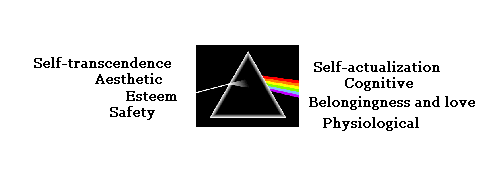
American psychologist, Abraham Maslow, published A Theory of Human Motivation (1943) in the Psychological Review Journal that theorized his hierarchy of needs model. This motivational model put forth that a higher need, such as self-actualization, is expressed only after lower needs are first fulfilled. This was one of the first psychology research projects that looked at mentally healthy human beings, rather than the mentally ill.
Dr. Maslow was one of the founders of humanistic psychology, who advocates a humanistic science rather than a classical mechanistic science.
Many things in life cannot be transmitted well by words, concepts, or books. Colors that we see cannot be described to a man born blind. Only a swimmer knows how swimming feels; the nonswimmer can get only the faintest idea of it with all the words and books in the world. The psychopath will never know happiness or love. The youngster must wait until he is a parent in order to know parenthood fully and to say “I didn't realize.” My toothache feels different than your toothache. And so it goes. Perhaps it is better to say that all of life must be first be known experientially. There is no substitute for experience, none at all. - Abraham H. Maslow in The Psychology of Science (1966).
For more information, see Maslow's Hierarchy of Needs