
Note: This site is moving to KnowledgeJump.com. Please reset your bookmark.
Defining eLearning
 Jay Cross (2004) has normally been credited with coining the term elearning in 1998. However, while Jay was certainly one of the biggest proponents of eLearning, the term seems to have been in use as far back as 1997 when Aldo Morri wrote an article for Telephony Online, A bright future for distance learning: One Touch/Hughes alliance promotes interactive 'e-learning' service:
“The market for corporate interactive distance learning—now known as 'e-learning,' has boomed along with the growth in the Internet and corporate intranets.”
Since then, it has generally taken four forms of definitions: Internet, Eccentric, Electronic, and Framework.
Internet and Network Based Definitions
Marc Rosenberg (2001) confines elearning to the internet as: the use of internet technologies to deliver a broad array of solutions that enhance knowledge and performance. It is based upon three fundamental criteria:
-
networked
-
delivered to the end-user via a computer using standard internet technology
-
focuses on the broadest view of learning
Allison Rossett (2001) defines elearning as: Web-based training (WBT), also known as elearning and on-line learning, is training that resides on a server or host computer that is connected to the World Wide Web.
She considers WBT or elearning as belonging to Technology-Based Training — training that is delivered partially or entirely through electronic hardware, software, or both (2001, p161).
These two definitions perhaps come the closest as to how most learning professionals define elearning.
Another one that pretty much stays within the network framework is Clark Adrich (2004). He defines elearning as: a broad combination of processes, content, and infrastructure to use computers and networks to scale and/or improve one or more significant parts of a learning value chain, including management and delivery.
Originally aimed at lowering management cost, while increasing accessibility and for measurability of employees, elearning is increasingly being used to include advanced learning techniques, such as simulations, communities of practice, and including customers and vendors as well.
Electronic Based Definitions
A somewhat different approach carries it beyond the internet to the computer itself. ASTD's Learning Circuits (now defunct) defined it as electronic learning covering a wide set of applications and processes, such as web-based learning, computer-based learning, virtual classrooms, and digital collaboration. It includes the delivery of content via internet, intranet/extranet (LAN/WAN), audio- and videotape, satellite broadcast, interactive TV, and CD-ROM.
Thus, this definition defines elearning as residing on electronics or mostly computer based.
Eccentric Based Definitions
Some definitions try to pinpoint it exactly, but end up missing the entire concept of it.
Everything but Training
in a Chief Learning Officer article (2003), Brook Manville defines elearning as: including not only Internet-published courseware, but also the tools for managing, modularizing and handling the following:
-
Different kinds of content and learning objects (including both electronic and non-electronic forms, and even traditional classroom instruction).
-
Just-in-time and asynchronous learning, such as virtual labs, virtual classrooms and collaborative work spaces.
-
Simulations, document repositories and publishing programs.
-
Tools for prescribing learning, managing development pathways and goals and handling e-commerce and financial transactions related to learning.
-
The utilities and capabilities for supporting informal learning, mentoring, communities of practice and other non-training interventions.
In other words, elearning does most everything in the corporate world related to learning except for training!
High Velocity Value Chains
In a Delphi Group white paper, Peter Drucker (2000), defines elearning as: just-in-time education integrated with high velocity value chains.
Whew — that is some mouthful! (don't get me wrong, I like Peter Drucker)
Experience
Elliott Masie defines the e in elearning as: the EXPERIENCE dimension of elearning, which includes such factors as: engagement, curiosity, simulation, and practice.
Framework Based Definition
Gilbert said that performance has two aspects: behavior being the means and its consequence being the end (1998). Learning is similar in that it also has two aspects: a learning method or experience being the means and the resulting skills or knowledge being the end (consequences).
Victor Jeurissen, global practice leader for IBM Management Development Solutions, defines elearning as: the use of innovative technologies and learning models to transform the way individuals and organizations acquire new skills and access knowledge (Moeng, 2004). He further defines learning as a collaboration of information, interaction, collaboration, and in-person.
Jeurissen's definition is the most interesting and promising in that like Gilbert, who refers to the two aspects of performance, he also refers to the two aspects — “innovative technologies and learning models” to provide the means, with the consequence being “acquiring new skills and access knowledge.”
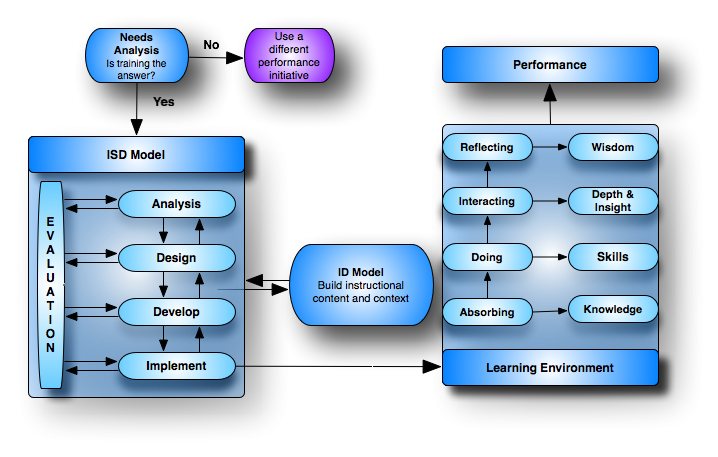
The “means” provide the learning experience of absorbing (such as reading or seeing) doing (activity), interacting (with people), and reflecting (connecting the new learnings with previous learnings).
Thus, the right skills and knowledge can be learned (consequence), if it is based on solid instructional design techniques:
Click the image for more information and to enlarge picture
The reason that we have to design and develop for the “right skills and knowledge” is that we are accountable to the organization for spending resources wisely. Victor Jeurissen reported that, “75% of CEOs think employee education is the most critical success factor relative to other people issues. Learning directly supports the top agenda of CEOs, business groups and customer responsiveness” (Moeng, 2004).
By viewing elearning or learning as having two aspects (means and consequences), we can better define learning's role in the organization.
Next Steps
-
Defining eLearning
Related Resources
Reference
Adrich, Clark (2004). Simulations and the Future of Learning. San Francisco: Pfeiffer, p.240.
Drucker, P. (2000). Need to Know: Integrating e- Learning with High Velocity Value Chains. A Delphi Group White Paper.
Cross, J. (2004). An Informal History of eLearning. On the Horizon, vol: 12, no 3, pp 103-110.
Manville, B. (2003). Organizing Enterprise-Wide eLearning and Human Capital Management. Chief Learning Officer, May, 2004.
Moeng, B. (2004). IBM tackles learning in the workplace. IBM Management Development Solutions, Nov 8, 2004.
Rosenberg, M. (2001). e-Learning: Strategies for Delivering Knowledge in the Digital Age. New York: McGraw-Hill, p28.
Rossett, A. Sheldon, K. (2001). Beyond The Podium: Delivering Training and Performance to a Digital World. San Francisco: Jossey-Bass/Pfeiffer, p274.