Note: This site is moving to KnowledgeJump.com. Please reset your bookmark.
Transformational Leadership
 Transformational leaders create something new from something old by changing the basic political and cultural systems (Tichy, Ulrich, 1984). This differs from transactional managers who make adjustments to the organizational mission, structure, and human resources.
Transformational leadership accomplishes this by challenging and transforming individuals' emotions, values, ethics, standards, and long-term goals through the process of of charismatic and visionary leadership (Northouse, 2007).
The term Transformational Leadership was first coined by Downton (1973), however, its emergence did not really come about until James Burn's classic, Leadership (1978), was published. Burn noted that the majority of leadership models and practices were based on transactional processes that focused on exchanges between the leader and followers, such as promotions for performing excellent work or punishment for being late. On the other hand, transformational leaders engage with their followers to create a connection that raises the level of motivation and morality in not only the followers, but also the leaders themselves.
Leadership Continuum
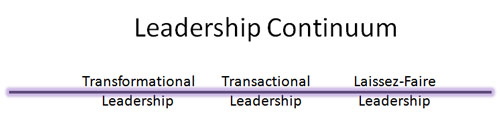
In 1985, Bass expanded on the transformational and transactional models by noting they were more of a continuum, rather than two separate entities. In addition, the concept of Laissez-faire or delegating was also on the continuum:
In addition, Bass wrote how transformational Leadership inspired the followers to do more by:
-
Raising their levels of consciousness of the organizational goals
-
Rising above their own self-interest for the sake of the organization
-
Address higher level needs
While charisma of the leader is necessary for the followers to achieve the above needs, other conditions are also necessary, such as motivational forces, intellectual stimulation, and individualized consideration. This chart shows some of the factors of the continuum that have been identified by researchers (Northouse, 2007, p.175):
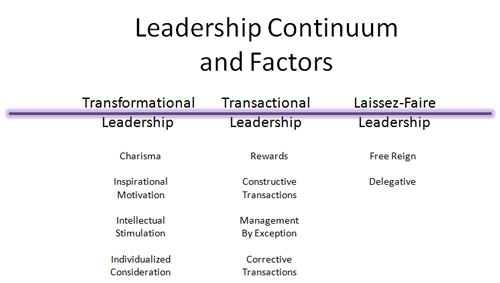
Since this is a continuum, the degree of separation between transformational and transactional leadership often falls in the gray, in addition, leaders will at times operate out of all three modes (transformational, transactional, and laissez-faire), rather than sticking with one.
For example, House (1976) identified these characteristics of a charismatic leader (charisma is one of the main identifiers of a transformational leader):
-
Strong role model
-
Shows competence
-
Articulates goals
-
Communicates high expectations
-
Expresses confidence
-
Arouses motives
One leader that comes to mind that has all the high marks of these characteristics is the late Steve Jobs of Apple. Although he sits on one part of the continuum as a transformational leader who shows the above qualities of a transformational leader, he would use the corrective transactions of a transactional leader, such as severe criticism (punishment) when a designer did not meet his expectations.
Another example is a transactional leader who places certain followers in a laissez-faire style environment in order to help them learn and grow and/or because they know more than her and are able to do a better job without her direct involvement.
The Leadership Continuum is similar to Leadership Styles in that while most good leaders mainly stick to one style, they use other techniques to fit the situation, rather than sticking with one mode.
Productivity and Social outcomes
Ames and Flynn (2007) tested groups of MBA students to determine how much people like their leaders and how many things the leaders actually accomplished. They discovered two main outcomes when it came to the level of assertiveness:
-
Productivity: Higher levels of assertiveness produced diminishing returns, thus it's not much better to be highly assertive than moderately assertive. However, it is definitely better to be moderately assertive than not assertive.
-
Social outcomes: Higher levels of assertiveness lead to increasingly poor social outcomes. It is definitely better to be moderately assertive than highly assertive.
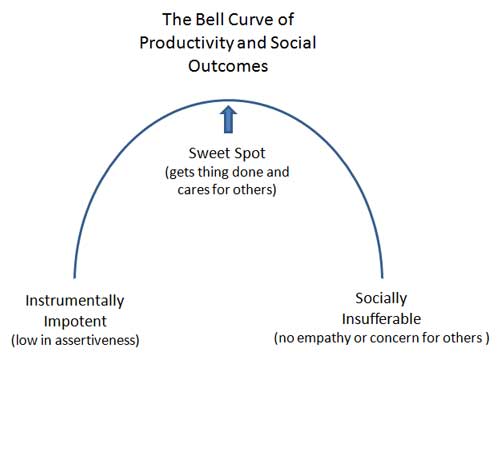
By putting both of the outcomes together we get an inverted U-shape (Bell curve)in that leaders who are low in assertiveness get less things done, but people very high in assertiveness are socially insufferable. In the middle of the curve are leaders who get the most things done in addition to to providing good social outcomes. The goal is to operate out of the sweet spot that is in the middle:
Ames and Flynn (2007) also discovered that assertiveness is how we most often evaluate leaders and co-workers in that assertiveness was complained about more than other important leadership qualities, such as charisma, conscientiousness, and intelligence. However, when leaders are moderately assertive, we don't tend to notice.
The belief that you get the best results in business by being roughshod with people is wrong, as is using too much of a soft approach. Just as with the Leadership Continuum and Leadership Styles, leaders need to discover their comfortable sweet spot that allows them to accomplish their goals, while at the same time producing a social environment that achieves the best from people.
Next Steps
Take the Transformational Leadership Survey
Next chapter: Social Leadership
References
Ames, D.R., Flynn, F.J. (2007). What Breaks a Leader: The curvilinear relation between assertiveness and leadership. Journal of Personality and Social Psychology, Vol 92(2), 307-324.
Bass, B.M. (1985). Leadership and Performance Beyond Expectations. New York: Free Press.
Burns, J.M, (1978). Leadership. New York: Harper and Row.
Downton, J.V. (1973). Rebel Leadership: Commitment and Charisma in the Revolutionary Process. New York: Free Press.
House, R.J. (1976). A 1976 Theory of Charismatic Leadership. In Leadership: The Cutting Edge. Hunt, Larson (eds). pp.189-207. Carbondale: Southern Illinois University Press.
Northouse, G. (2007). Leadership Theory and Practice. Thousand Oaks, CA: Sage Publications, Inc.
Tichy, N.M., Ulrich, D.O. (1984). The Leadership Challenge—A Call for the Transformational Leader. Classical Readings of Organizational Behavior (2008). Ott, Parkes, Simpson. Belmont (eds). CA: Thomson-Wadsworth .