Note: This site is moving to KnowledgeJump.com. Please reset your bookmark.
OODA Loop
The OODA Loop model was developed by Col. John Boyd, USAF (Ret) during the Korean War. It is a concept consisting of the following four actions:
- Observe
- Orient
- Decide
- Act
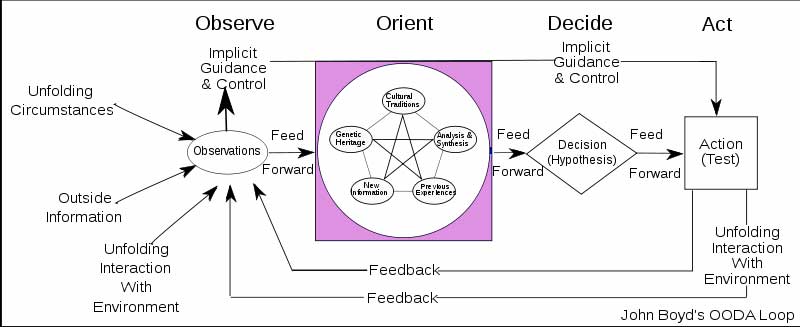
This looping concept referred to the ability possessed by fighter pilots to cycle through the four actions that allowed them to succeed in combat. It is now used by the U.S. Marines and other organizations. The premise of the model is that decision-making is the result of rational behavior in which problems are viewed as a cycle of Observation, Orientation (situational awareness), Decision Making, and Action. Boyd diagramed the OODA loop as shown in the figure below:
Cycling Through OODA
An entity (whether an individual or an organization) that can process this cycle more quickly than an opponent can “get inside” and disrupt the opponent's decision cycle to gain the upper advantage.
Observation
Scan the environment and gather information from it. Gather as much current information from as many sources as possible. One of the key challenges to effective observation is knowing what information to monitor and applying the right filters to each piece of information.
Orientation
Use the information to form a mental image of the circumstances. That is, synthesize the data into information. As more information is received, you "deconstruct" old images and then "create" new images.
Note that different people require different levels of details to perceive an event. Often, we imply that the reason people cannot make good decisions is that people are bad decisions makers — sort of like saying that the reason some people cannot drive is that they are bad drivers. However, the real reason most people make bad decisions is that they often fail to place the information that they do have into its proper context. This is where "Orientation" comes in. Orientation emphasizes the context in which events occur, so that we may facilitate our decisions and actions. That it, orientation helps to turn information into knowledge. And knowledge, not information, is the real predictor of making good decisions.
Boyd also identified five main forces that influence our decisions:
- Cultural traditions
- Genetic heritage
- The ability to analyze and synthesize
- Previous experience level
- New information coming in
Decision
Consider options and select a subsequent course of action. The goal is to make better and faster choices than your opponent. The ability to predict the future can make the difference between success or failure.
Action
Carry out the conceived decision. Once the result of the action is observed, you start over. Note that in combat or when competing against others, you want to cycle through the four steps faster and better than the competition, hence, it is a loop, rather than a one-time affair.
Finally, the actions and reasoning behing it should be tranmitted to others through the use of an After Action Review.
Interactive Web
The loop doesn't mean that individuals or organizations have to observe, orient, decide, and act, in the order as shown in the diagram above. Rather, picture the loop as an interactive web with orientation at the core, as shown in the diagram below. Orientation is how we interpret a situation, based on culture, experience, new information, analysis, synthesis, and heritage
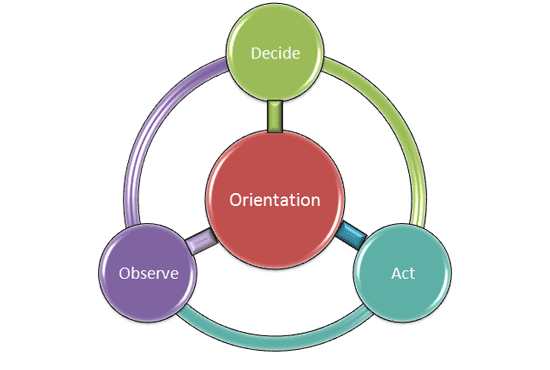
Thus, the loop is actually a set of interacting loops that are kept in continuous operation.
SOAP
Another variation of the OODA cycle is SOAP that is used by paramedic's and medical techs. SOAP is a standard process for:
- Situation
- Observation
- Analysis
- Perform
Next Steps
Next chapter: Time Management
Learning activity: OODA and Double-Loop Learning
Reference
Boyd, J.R. (1987). A discourse on winning and losing. Maxwell Air Force Base, AL: Air University Library Document No. M-U 43947.
Brehmer, B. The Dynamic OODA Loop: Amalgamating Boyd’s OODA Loop and the Cybernetic Approach to Command and Control. Stockholm: Department of War Studies Swedish National Defence College.